



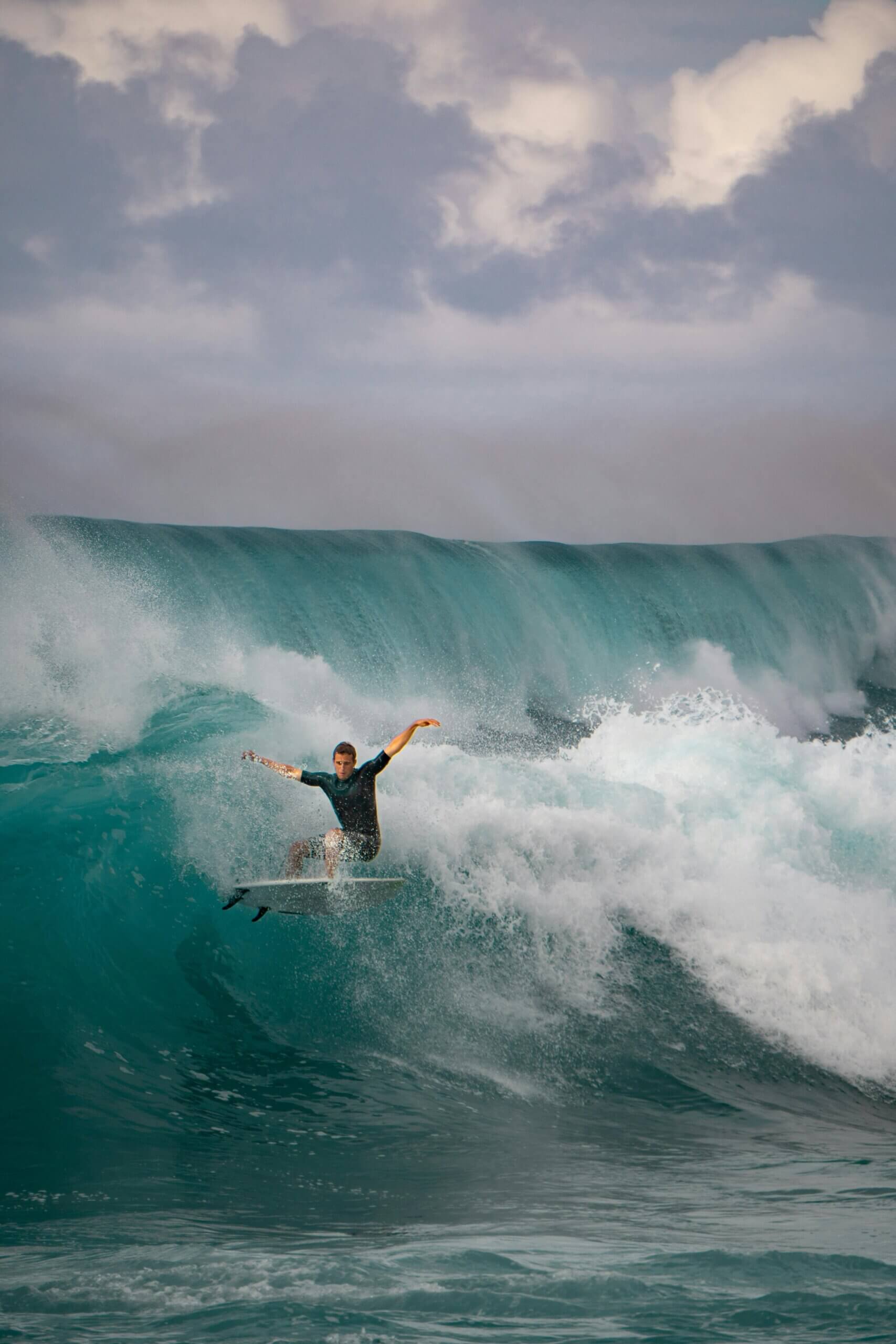
01 Apr The Truth About Surf Confidence: How to Feel in Control on Bigger Waves
You Think Confidence Feels Like Certainty. It Doesn’t.
Surf confidence in bigger waves does not arrive as calm assurance. It does not tap you on the shoulder and say, “You’re ready.”
It arrives disguised as a quiet contradiction.
You paddle knowing two things at once:
This might work.
This might not.
And strangely, that is enough.
Most surfers wait for a feeling that never comes. A sense of total readiness. A moment where the mind goes silent and the body follows obediently.
That moment is fiction.
What actually happens is more interesting. Confidence grows in parallel with doubt, not in its absence.
Surf Confidence in Bigger Waves Is Not About Control. It Is About Tolerance
Here is the uncomfortable truth.
You never become fully in control of bigger waves. You simply become better at tolerating how little control you have.
That tolerance is the real skill.
Beginners often interpret hesitation as lack of ability. But hesitation is often a negotiation. Your brain is calculating risk, timing, positioning, past experiences, and future consequences in milliseconds.
In smaller waves, that negotiation is forgiving. In bigger waves, it becomes exposed.
So surfers misread the situation. They think they need more courage.
What they actually need is a wider tolerance for uncertainty.

The Invisible Moment That Changes Everything
There is a moment in every wave that rarely gets discussed.
It happens just before commitment.
Not when you see the wave. Not when you start paddling. But in that microsecond where you decide:
“I am no longer backing out.”
That moment is not physical. It is psychological.
And most surfers leak energy there.
They hesitate slightly. They second-guess. They paddle with partial intent.
The wave feels harder, faster, less forgiving.
But the wave did not change.
Their commitment did.
Bigger Waves Don’t Require More Skill. They Require Cleaner Decisions.
This is where things get iconoclastic.
Surfing bigger waves is not always about having more technique. It is about having less internal noise.
On smaller waves, you can surf with messy thinking:
- late reactions
- overcorrections
- fragmented focus
On bigger waves, that noise becomes friction.
The surfers who appear “confident” are not necessarily more skilled.
They are simply less divided internally.
They decide, and their body follows without argument.

The Myth of “Pushing Yourself”
There is a popular idea that to improve, you must constantly push past fear.
That sounds heroic. It is also incomplete.
If you push without understanding, you reinforce chaos.
If you avoid without awareness, you reinforce fear.
Real progression sits in a narrower space.
It is the ability to step slightly beyond your current comfort zone, while still being able to observe what is happening.
Not overwhelm. Not avoidance.
Participation with awareness.
Why Some Surfers Suddenly “Click”
You have seen it.
Someone struggles for weeks, then something shifts. Not dramatically. Quietly.
They start catching waves earlier. Moving smoother. Looking… less urgent.
It is tempting to say their technique improved.
But often, what changed is simpler.
Their perception reorganized.
They stopped trying to control every second and started trusting sequences:
- where to sit
- when to paddle
- when to commit
This kind of clarity rarely comes from isolated sessions.
It tends to emerge in environments where patterns repeat and are reflected back. Where someone can say, “You’re hesitating right here,” and suddenly you see it.
In places where surfers spend continuous time in the water with that kind of guidance, the shift happens faster. Not because the waves are easier, but because the learning is less random.
That is naturally embedded in setups like Wave House, where surfing is not just done, but interpreted.
Control Is Not What You Think It Is
There is a paradox at the center of surfing.
The more you try to control the wave, the less control you feel.
The more you align with it, the more stable everything becomes.
Control, in this sense, is not force.
It is timing meeting acceptance.
You cannot slow the wave down.
But you can be early.
You cannot shape the face.
But you can choose your line.
You cannot eliminate uncertainty.
But you can stop resisting it.
That is what surfers call confidence, even if they do not phrase it that way.
Actionable, But Not Obvious
- Notice where you hesitate. That is your real training ground
- Watch your paddling intention. Half-commitment creates instability
- Let go of “perfect waves.” Look for clean decisions instead
- Reduce internal commentary. The wave is already giving enough information
- Spend time in surf environments where patterns are seen, not guessed
The Shift That Stays
Surf confidence in bigger waves is not something you achieve once and keep forever.
It is something you renegotiate, session after session.
Some days it feels close. Some days it feels distant.
But over time, something stabilizes.
Not the ocean.
You.
And when that happens, bigger waves stop feeling like something to conquer.
They start feeling like something you can enter, fully aware that you are not in control, yet somehow not at the mercy of it either.
That space in between is where real surfing begins.