
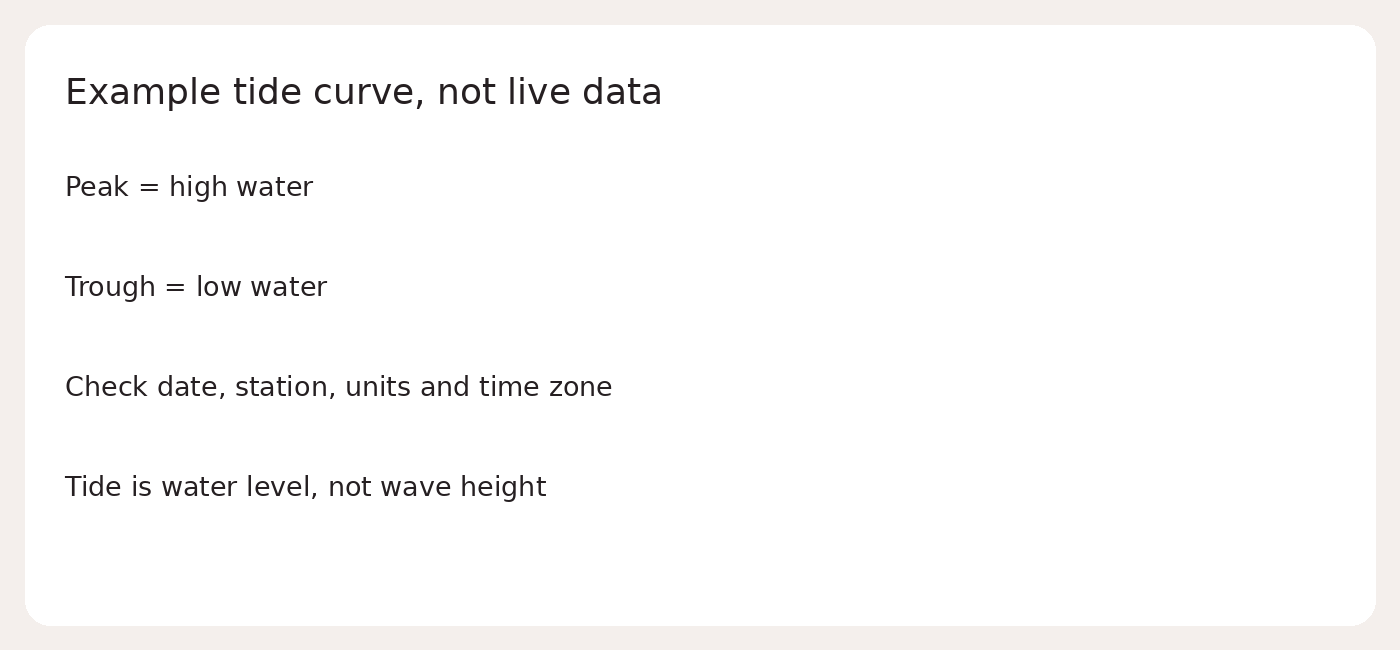
A Bali tide chart shows predicted water height over time, not the size of breaking waves. Choose the nearest relevant station, check the date, time zone and units, then compare the forecast with the actual beach. There is no single tide that suits every Bali surf spot or every beginner.
Check today's tide
Use the BIG tide portal and BIG tide model information. Select the relevant area and date and check the time zone. These predictions are not a navigation or surf-safety guarantee. A local coach should assess conditions before you enter.

How to read a Bali tide chart
- Choose the correct location and date, not an old example chart.
- Check the time zone. Bali uses WITA, UTC+8.
- Check whether height is in metres or feet and what reference datum is used.
- Find the high and low water times and the rising or falling curve.
- Compare the tide with swell, wind, hazards and your ability.
Tide guidance for Canggu surf spots
The following is from WaveHouse's current spot guide. A tide window is a starting point, not a promise of safe waves.
For east-coast and Bukit reef breaks such as Keramas, Nusa Dua, Padang Padang, Green Bowl and Uluwatu, get spot-specific local guidance. This article does not publish unverified tide rules for those breaks. Uluwatu is surf-spot information only, not a WaveHouse camp booking recommendation.
Tide chart vs swell chart
Tide is water level changing over time. A swell forecast describes wave height, period and direction offshore. Both affect a session, along with wind and the seabed. Read swell direction explained rather than assume a higher tide means bigger swell.
What makes the tide change
The moon and sun influence tides. At new and full moon their alignment creates a larger tidal range, called spring tides. Quarter-moon phases generally have a smaller range, called neap tides. NOAA explains spring and neap tides; see moon and surf for planning context.
How often do tides change?
NOAA describes a lunar day as about 24 hours 50 minutes. In a typical semidiurnal pattern, high tides are about 12 hours 25 minutes apart. Local patterns vary, so use the relevant station's actual prediction instead of forcing every day into a fixed two-high-tide schedule. Read NOAA's lunar-day explanation.
Where to check tide and swell
Check the BIG sources above for Indonesian tide information, then compare a current surf forecast and a local beach assessment. Do not use the old March 2016 chart as live data. Wind, storms and local currents can make the observed conditions differ from a tide-only prediction.
Frequently asked questions
What is the best tide for surfing in Bali?
There is no island-wide best tide. The break, seabed, swell, wind and your level all matter. WaveHouse's Canggu guide favors mid to high tide at several local breaks and mid tide at Pererenan. Check the relevant forecast and ask a local coach about the actual entry and hazards.
Is high or low tide better for beginners in Canggu?
Do not choose by tide alone. WaveHouse's guide generally favors mid to high tide at Batu Bolong and Berawa, but suitability depends on the specific peak and conditions. Low water can expose reef hazards. A beginner should let a coach choose manageable whitewater and explain the entry and exit.
How many high tides are there in Bali each day?
Many coasts have a semidiurnal pattern with two highs over a lunar day of about 24 hours 50 minutes, according to NOAA. Local patterns and calendar-day counts vary. Use the relevant Bali station's prediction for your date rather than assume exactly two highs in every midnight-to-midnight day.
Where can I check today's Bali tide?
The BIG tide portal and tide-model information provide official Indonesian tide resources. Choose a station or area relevant to your surf spot and check the date, units and time zone. A prediction is only one part of preparation; compare it with wind, swell and a local assessment before entering.
Plan your next session
Explore WaveHouse packages or surf lessons in Canggu. Ask the team to match your level and dates with the right option.
Updated 13 October 2026.
Details
Author