These ten beginner surf tips follow the order of a session: before you paddle out, in the water and standing up. Use them as preparation for coaching, not as permission to enter conditions beyond your ability.
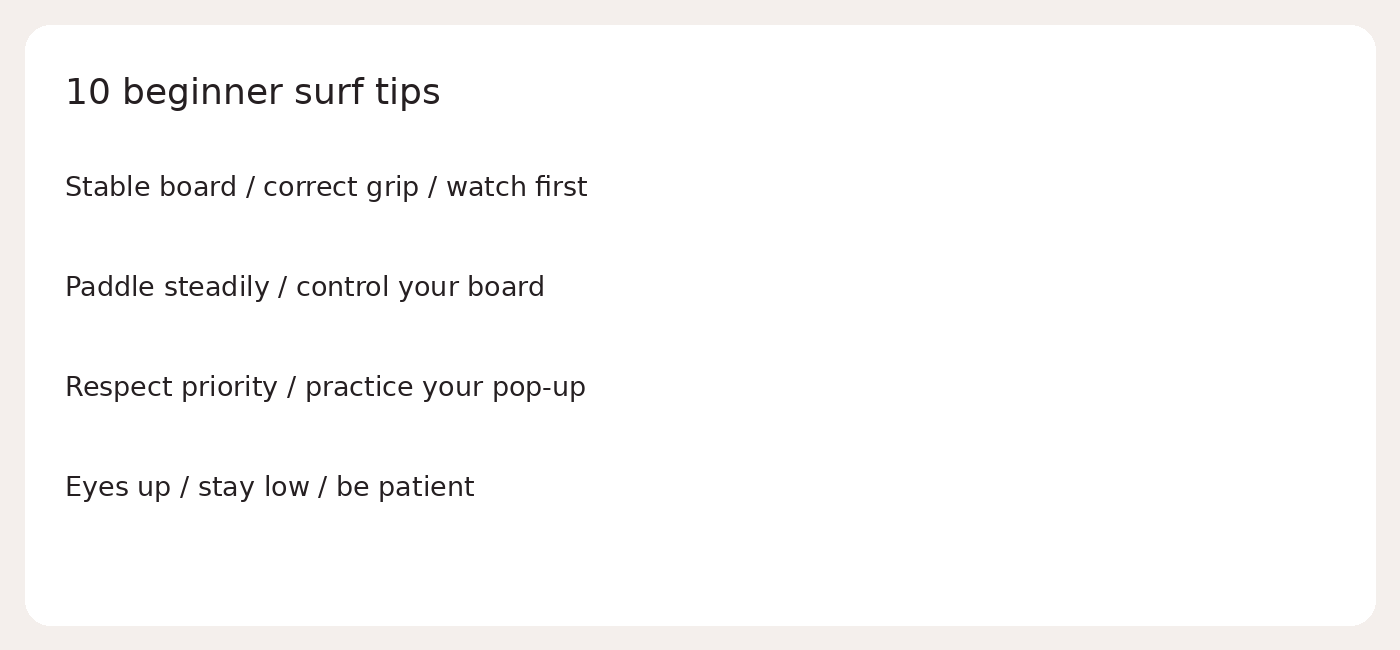
10 tips at a glance
- Start on a stable soft-top board
- Wax a hard board properly (check the soft-top deck)
- Watch the waves before you paddle
- Paddle smart, not hard
- Know your escape plan
- Respect the lineup
- Practise your pop-up on land first
- Keep your eyes up
- Stay low and centered
- Laugh off the wipeouts
Before you paddle out
1. Start on a stable soft-top board
Choose stability over looks. A long, wide, high-volume board is steadier and easier to catch waves on. Soft-top (foam) boards are also softer when you fall. Beginners at WaveHouse learn on a soft-top longboard. Not sure what suits you? Read our guide to choosing a surfboard for your body type, the overview of surfboard types and the surf equipment list.
2. Wax a hard board properly (check the soft-top deck)
Wax gives grip on a hard (fiberglass) board. Apply it in circular motions where your feet land and on the rails where you grab for a turtle roll. Soft-top deck grip varies; follow the board maker and coach before adding wax. Details in our guide on how to wax a surfboard (and how often).
3. Watch the waves before you paddle
Take five minutes on the beach. Notice where the waves break, where other surfers sit and how the current moves. That helps you avoid paddling into someone's path or into a rip current. Rip currents pull you away from shore, not under the water. If you are caught in one, stay calm, do not swim against it, and swim parallel to the shore until you are out of the current, then angle back to the beach. If you cannot get out, float and wave for help. More in our rip current guide.
In the water
4. Paddle smart, not hard
Use long, deep strokes instead of frantic splashing. Keep your body centered on the board and arch your back slightly so the nose does not dip. Think of gliding through the water, not fighting it. Paddling is where many beginners tire out first.
5. Know your escape plan
Ask your coach which controlled technique suits your board and the conditions. Do not grab or wrap the leash around your hand and do not throw the board toward others. Keep clear space, protect your head after a fall, and do not paddle out without an entry and exit plan.
6. Respect the lineup
Respect priority and wait your turn. A drop-in means taking a wave while a surfer with priority is already riding; snaking means paddling around others to take position. Ask about local rotation and keep clear of the rider's line.

Standing up
7. Practise your pop-up on land first
Learn the movement on the beach, or even on your bed at home, before you try it on a moving board. Start in a push-up position, then bring your feet under you in one smooth motion. The more you repeat it, the smoother it gets in the water. Full steps in how to pop up on a surfboard.
8. Keep your eyes up
Look where you want to go. Staring at your feet is one of the most common beginner mistakes. Your body follows your gaze, so keep your eyes on the horizon or the direction you want to ride.
9. Stay low and centered
Resist standing tall. Bend your knees, keep your arms loose for balance and feel the wave beneath your feet. The lower your center of gravity, the steadier the ride.
Mindset
10. Laugh off the wipeouts
You will fall. Every surfer does, including the best. The difference is that they get back up. Treat each fall as a lesson and paddle out for the next wave.
Beginner tips for Bali
- Pick a beginner-friendly spot. Read about surfing in Canggu. Our coaches choose the spot each morning based on conditions and your level.
- Check the tide with our tide chart guide.
- Wear surf zinc for sun protection.
- Check whether the break is over reef and what footwear that calls for: see the surf equipment list.
- Do not surf alone, and ask locals or your coach about currents before you paddle out.

Two bonus tips
Know what normal progress looks like
Falling a lot, tiring quickly and feeling like you are not getting it yet are all normal. They do not mean surfing is not for you. Our guide on how long it takes to learn surfing shows what to expect.
Get a second pair of eyes
A coach can spot the one small fix, such as foot position, timing or a board that is too small, that is holding back your whole session. That is the idea behind surf lessons in Canggu.
Beginner surf FAQ
How long does it take to learn to surf?
Learning time varies by person, conditions and practice. A first stand-up is different from consistent board control or riding unbroken waves. Ask a coach to assess your starting level and focus on manageable steps rather than a guaranteed result within a fixed number of lessons.
What size board should a beginner use?
Start on a stable, wide, high-volume soft-top board, usually a longboard. It gives you more balance and makes catching waves easier. Beginners at WaveHouse learn on a soft-top longboard. Your height, weight and skill change the best fit, so ask your coach to match a board to you.
Is surfing in Bali safe for beginners?
Beginners can learn safely with the right spot, conditions and supervision. At WaveHouse, coaches choose the surf spot each morning for conditions and level, run beach theory on safety and etiquette, and teach in small groups with a coach in the water. Always check the waves and currents first.
Final thoughts
Surfing has a learning curve, and these tips will not remove every wipeout. They will help you enjoy the process, build confidence and feel part of the lineup sooner.
Ready to try? Book surf lessons at WaveHouse in Canggu, or stay with us at the WaveHouse surf camp. Not sure which level suits you? Read surfing levels explained.
Details
Author