The pop-up is the move from lying on your board to standing. Here are the five steps, when to pop up, the mistakes to avoid and drills you can do at home. WaveHouse coaches teach the pop-up every day in Canggu.
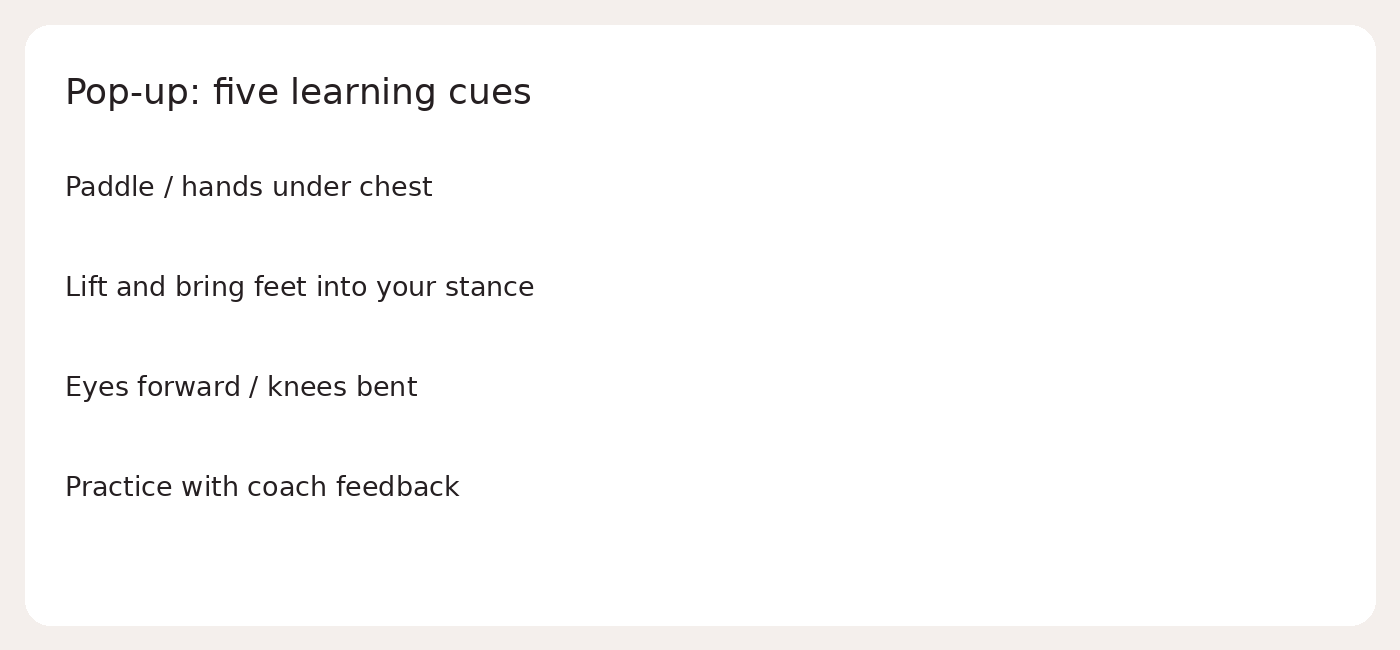
5 steps at a glance
- Paddle with purpose
- Find your power position
- Push up and pop
- Eyes on the horizon
- Stay low and balanced
What is the surf pop-up?
The pop-up is the smooth transition from lying on your board to standing in your riding stance. A solid pop-up sets up the whole ride. It is less about strength and more about technique, timing and muscle memory. If you wonder how hard surfing is, the pop-up is the part that takes the most repetition: see is surfing hard?. Once you pop up consistently on whitewater, the next skill is getting past the breakers: duck diving vs turtle rolling.
How to pop up: 5 steps
1. Paddle with purpose
As the wave lifts you, paddle hard and keep your eyes forward. Commit to the wave before you start to stand.
2. Find your power position
Place your hands under your chest with your fingers spread wide and your elbows tucked in. You are about to push up.
3. Push up and pop
Lift your chest and bring your feet into the riding stance your coach has shown you. Different learners and boards use different sequences. Ask for hands-on feedback about foot placement and stance width rather than force an unverified universal back-foot-first rule.
4. Eyes on the horizon
Look forward, or in the direction you want to go. Looking down is a fast way to fall. Where your eyes go, your body follows.
5. Stay low and balanced
Bend your knees, keep your arms relaxed but firm for balance and feel the board under your feet. You are standing.

When to pop up (timing)
Pop up when the wave has picked you up and you are already paddling with it. Paddle hard as the wave lifts you, then push up. Popping up before the wave has you means you are standing on a board that is not yet moving with the wave. If you keep missing waves or stalling, bring it up with your coach, who can see your timing from the water and on video.
Beginners also get a wave-reading head start from how to read waves like a pro.
Common pop-up mistakes and fixes
Dry-land drills for pop-up power
You do not need waves to practise. A floor or a yoga mat is enough.
- Pop-up reps: 3 sets of 10 pop-ups daily. Muscle memory is your best friend.
- Plank to push-up: hold a plank, then push up into your pop-up position.
- Balance training: stand on a wobble board or a pillow to build stability.
Practising on the sand before your session works too. It is the same idea as our beginner surf tips: learn the movement on land first.

How long until the pop-up feels natural?
The time needed varies with your starting point, conditions and practice. Some learners manage a first stand-up early, but consistency takes repetition and feedback. There is no guaranteed day-one, one-week or one-month result. Practice the technique your coach recommends in conditions suited to your level.
Pop-up on a longboard vs a shortboard
It is the same movement on any board, but the timing feels different. Longer, higher-volume boards, the kind most beginners start on, are a more stable platform and give you a little more time to find your feet. Shorter, lower-volume boards need a faster, more compact pop-up and are less forgiving if you are slow or off balance. If your pop-up feels solid on a longboard but falls apart on a smaller board, that is normal. You probably need a few more sessions before sizing down. See matching your board to your body type and skill level and surfboard types.
The jump pop-up
The step-by-step pop-up above suits a longboard or foam board. On a smaller, lower-volume board it can be too slow. The board may stall or slip out, or you may miss the pocket of the wave. Shortboarders use the jump pop-up (also called jump-to-feet): they spring from lying down into their stance in one motion, both feet landing together, knees bent to absorb the landing. It takes more explosive strength and sharper timing, so it is not where beginners start.
Which pop-up should you use?
- On a foam board or longboard, or still building consistency on whitewater, stick with the step-by-step pop-up. It is more forgiving and easier to learn correctly.
- On a performance shortboard and catching unbroken (green) waves with some consistency, start drilling the jump pop-up, ideally on the sand first.
- Most surfers do not switch overnight. It is common to use the step-by-step method on slower waves and the jump pop-up on steeper, faster ones.
Not sure which suits your board and the waves? Ask an instructor. Not sure which program fits your level? Read surfing levels explained.
Pop-up FAQ
When should I pop up?
Pop up once the wave has lifted you and you are paddling with it, not before. Paddle hard as the wave picks you up, then push up in one smooth motion. If you are not sure about your timing, ask a coach to watch you, because timing is easier to judge from the water.
How long does it take to learn the pop-up?
The time needed varies with your starting point, conditions and practice. Some learners manage a first stand-up early, but consistency takes repetition and feedback. There is no guaranteed day-one, one-week or one-month result. Practice the technique your coach recommends in conditions suited to your level.
Should I use my knees?
No. Using a knee to get up makes the pop-up slower and wobblier. Push your chest up with your hands, then bring your feet under you in one smooth motion. If you keep reaching for a knee, practise the push-up and pop on the sand until it feels natural.
Which pop-up is best for beginners?
The step-by-step pop-up. It is more forgiving and easier to learn correctly on a foam board or longboard, and while you are still building consistency on whitewater. The jump pop-up is for surfers on smaller performance boards who are catching unbroken waves regularly.
Why do I keep falling when I pop up?
Common causes are looking down at your feet, using a knee, or not having enough pushing power to get all the way up. Keep your eyes on the horizon, push up instead of using a knee, and practise the movement on land. A coach can spot the exact cause.
Practise the pop-up with a coach
Coaching can help identify what to change in your pop-up. At WaveHouse in Canggu, a beginner gets a soft-top longboard and a coach in the water, in small groups, plus surf theory on land and video analysis after each session. Book surf lessons in Canggu or look at the WaveHouse surf camp in Canggu.
Details
Author