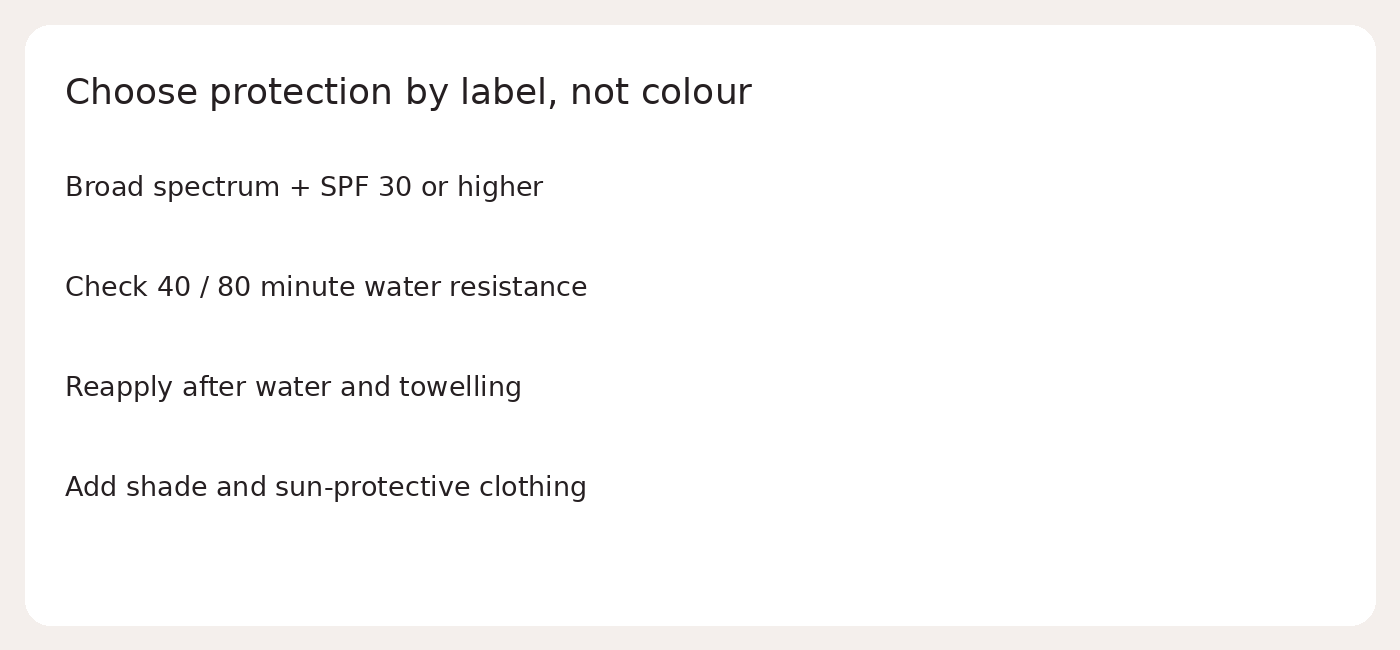
Surf zinc is a sunscreen product commonly made with the mineral UV filter zinc oxide. The stripe is visible, but thickness or colour alone does not prove protection. Choose a labelled broad-spectrum, SPF 30 or higher, water-resistant sunscreen and follow its directions. Zinc is one option, not a reason to avoid other suitable sunscreen.
General information, not medical advice. Ask a dermatologist about persistent irritation, allergies or your child's needs.

What is surf zinc?
Zinc oxide and titanium dioxide are mineral sunscreen ingredients. Surf products may come as a paste, stick or cream, with colour added. Check the actual ingredient and protection labels rather than assume every coloured zinc product has the same SPF or water resistance.

Surf zinc vs other sunscreen
The American Academy of Dermatology says the best sunscreen is one you will use consistently, with broad-spectrum protection, SPF 30 or higher and water resistance. Avoid sweeping claims that one ingredient makes all alternatives unsafe. AAD sunscreen guidance.
Zinc oxide vs titanium dioxide
Both are mineral options. Choose the complete formulation and label for your skin and activity rather than rank them by unsupported claims about antioxidants or free radicals. AAD notes mineral ingredients may be less irritating for sensitive skin, including some children. Stop using a product that causes irritation and seek advice.
How to apply surf zinc
- Follow the product label, including how long before exposure to apply it.
- Apply evenly to exposed skin, including nose, cheeks, forehead and ears. Do not miss areas just because a stripe looks thick.
- Keep it out of the eyes. Use a labelled SPF lip product on lips rather than an unlabelled paste.
- Reapply as the label directs and after towelling, swimming or sweating.
- After the session, wash gently with an appropriate cleanser following the product directions. Avoid harsh scrubbing.
How long does surf zinc last?
There is no universal two-hour water guarantee. AAD explains that water resistance is tested for 40 or 80 minutes. Even on dry skin outdoors, reapply about every two hours. After towelling and water exposure, follow the label's reapplication directions. No sunscreen is waterproof. Read the AAD label guide.
How to choose surf zinc
- Broad-spectrum protection for UVA and UVB.
- SPF 30 or higher.
- Labelled water resistance appropriate to the session.
- An ingredient list you can check for sensitivities.
- A finish you will use properly and reapply. Colour is not a measure of SPF.
No generic "reef-safe" claim is made here. Add shade, a rash guard and other sun-protective clothing. For personal gear and skin friction, read surf equipment and surf rash information.
Sources
Checked 13 October 2026: AAD sunscreen labels and AAD sunscreen guidance.
Frequently asked questions
Is surf zinc better than sunscreen?
Surf zinc is itself a sunscreen product, commonly using zinc oxide. It is not automatically better than every other formula. AAD recommends broad-spectrum protection, SPF 30 or higher and water resistance. Choose a product you will apply correctly and reapply, and add clothing and shade rather than relying on a visible stripe.
How long does surf zinc last?
Check the specific label. Water-resistant sunscreen is tested for 40 or 80 minutes, according to AAD guidance; it is not waterproof. Reapply as directed after swimming, sweating or towelling and about every two hours outdoors on dry skin. A thick layer does not override the product's reapplication instructions.
Can kids use surf zinc?
Use an age-appropriate labelled product and follow pediatric or dermatology advice. AAD recommends broad-spectrum, water-resistant SPF 30 or higher for exposed skin in children six months and older, and notes mineral ingredients may cause less irritation. Infants need extra care, shade and protective clothing; ask a clinician about their specific needs.
How do I remove surf zinc?
Follow the product's removal directions and wash gently with a cleanser suitable for your skin. Some formulations need a cleanser that removes water-resistant sunscreen. Avoid harsh scrubbing, especially on irritated skin, and keep products out of the eyes. If redness or discomfort persists, stop using the product and seek medical advice.
Plan your next session
Explore WaveHouse packages or surf lessons in Canggu. Ask the team to match your level and dates with the right option.
Updated 13 October 2026.
Details
Author