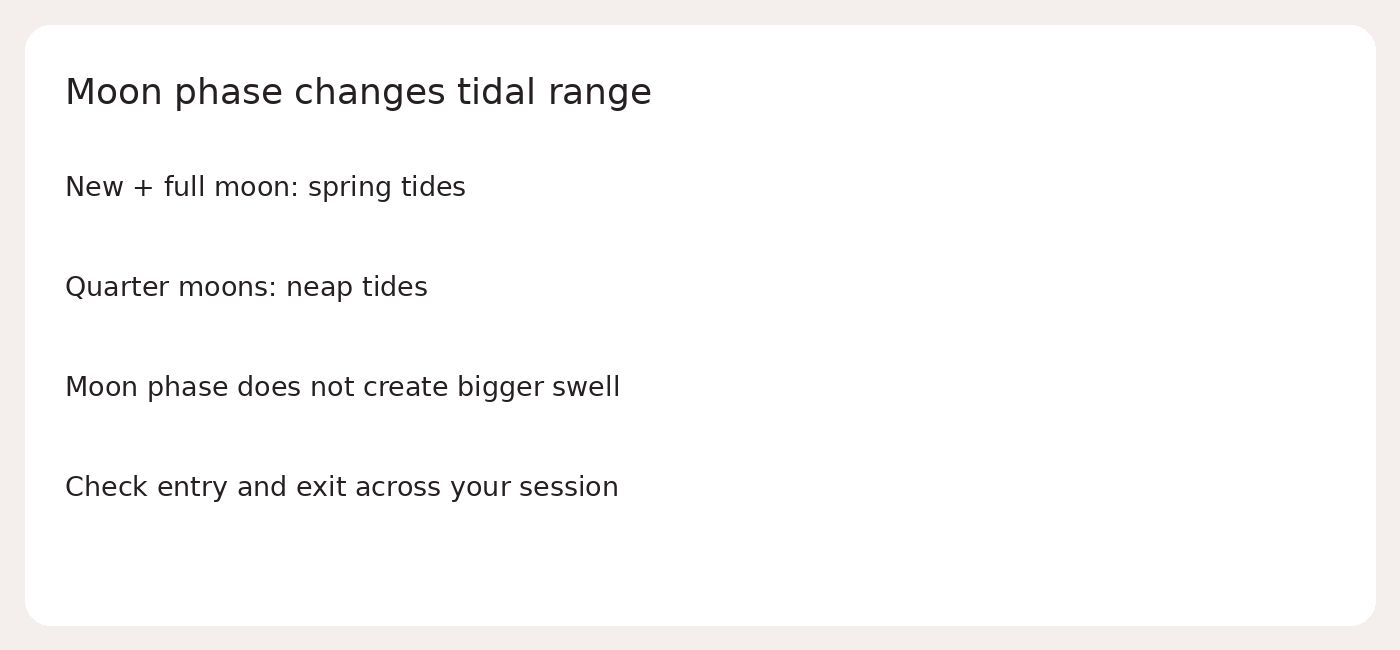
The moon affects surfing through tides, not by making the swell bigger. New and full moons usually bring a larger tidal range called spring tides; quarter moons bring a smaller range called neap tides. The useful question is how the changing water level affects your chosen break, entry and exit.
How the moon changes the tide
Spring refers to the range of tides, not the season. The sun, moon and Earth align at new and full moon; their tide-producing effects combine. See NOAA's explanation.

Neap tides: a smaller range
A smaller tidal range can mean less change in reef coverage over the session, but it does not guarantee a longer safe window or gentler waves. Strong swell, local currents and an exposed entry can still make a neap day demanding.

Spring tides: a larger range
Expect a bigger difference between high and low water. Check how the spot changes as the tide rises or falls and whether the exit will still be manageable later. Do not rely on the previous day's session time or assume a full moon rules out surfing.

The surfing windows most people miss
Read the full tide curve, not only the next high-water time. Your session needs enough water for the chosen break and a safe entry and exit. Exact windows are spot-specific. This guide does not claim a universal 20-minute window or guaranteed slack current at a tide turn.

A simple plan: spring vs neap days

Using the moon when you travel to Bali
For trip planning, use November to March as the wet-season window, April to October as the drier west-coast surf window, and expect variable transition conditions around October-November and March-April. These are planning guides, not fixed weather dates. Check BMKG and the daily forecast.
Moon phase is an extra planning tool, not a replacement for the tide chart or a swell forecast. WaveHouse's lesson page says coaches assess daily conditions and ability when choosing a spot. No special lunar scheduling or guest testimonial is claimed here.
Frequently asked questions
Does the moon affect surfing?
Yes, through the tide. The gravitational influence of the moon and sun changes water level and tidal range, which can affect reef coverage and a break's shape. The moon does not generate the ocean swell. Check tide, swell, wind and local hazards together before deciding when and where to surf.
Is a spring tide good for surfing?
It can be suitable at some breaks and unsuitable at others. Spring tides have a larger high-to-low range, so reef coverage and entry conditions may change more during a session. Whether it works depends on the spot, swell, wind and your ability. Ask a local coach rather than judging by moon phase alone.
What is a neap tide?
A neap tide is a period of smaller tidal range, generally around the first and third quarter moon. The high tides are less high and low tides less low than during spring tides. It does not mean the ocean is calm or that every surf break is suitable for beginners.
Does a full moon make waves bigger?
A full moon contributes to spring tides, with a larger difference between high and low water. It does not create larger swell. Swell is generated by wind, often far from the coast. Tide can change how waves break at a spot, so separate the swell forecast from the tide forecast.
Plan your next session
Explore WaveHouse packages or surf lessons in Canggu. Ask the team to match your level and dates with the right option.
Updated 13 October 2026.
Details
Author